For small business

The same analytics for any small business

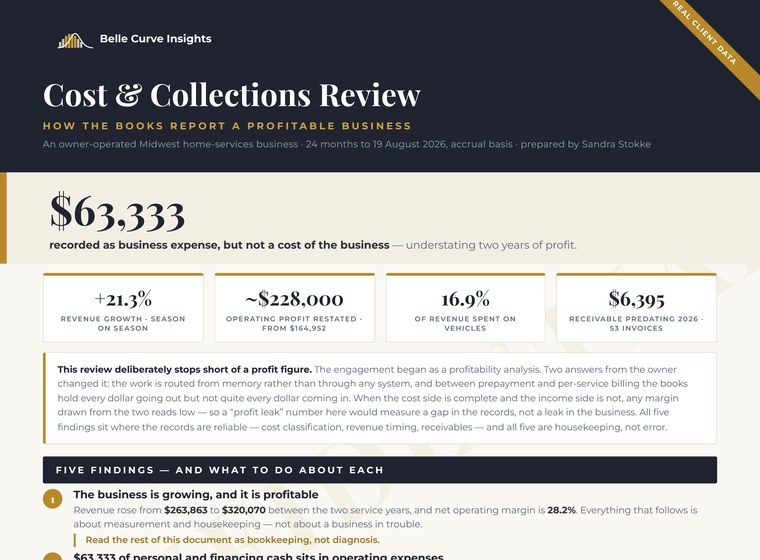
Not a practice? The Profit Audit works for any business with numbers to mine. A QuickBooks export is enough to start — and when there is point-of-sale data too, the questions we can answer multiply: which customers, which items, which hours actually make you money.

The method does not care what you sell. Take a defined set of transactions, follow every dollar to where it actually landed, and separate the money that was never collectible from the money that leaked. In a shop that means margin, inventory and card fees. In a service business it means job costs, recurring plans and receivables. Same arithmetic.

Two examples

Small-business figures are illustrative examples and fully de-identified — no real client data.

The same analysis, at a different scale

Before Belle Curve Insights I spent more than twenty years in analytics — leading risk analytics at Citigroup and Wells Fargo, then specialising in CRM across two global marketing agencies. That meant customer analytics for Fortune 500 brands including Johnson & Johnson and McDonald’s, where I worked across more than ten markets worldwide. The work was figuring out which customers, products and locations actually drove profit, and which quietly drained it.

Nothing about that method requires a Fortune 500 budget. It requires transaction-level data and someone willing to read it, roll it up, and interpret it carefully. A shop with 900 transactions a month has the same questions a national chain has — which items carry the margin, which promotions cost more than they returned, which hours are worth staffing — and, unlike the chain, can act on the answer the same week.

The reason small businesses rarely get this is cost, not complexity. A full-time analyst runs north of $200,000 a year. A fixed-fee audit does not.

Any system that records a transaction

The audit runs on transaction-level detail, and it does not much matter which system produced it. Point-of-sale exports, e-commerce platforms, booking and scheduling software, accounting systems — if it records what was sold, at what price, to whom, and when, it can be followed forward.

That matters because most small businesses already sit on more usable data than they realise. A POS export is not a report anyone reads; it is a complete record of every transaction, and almost nobody mines it.

What you exportWhat it can answer
Point-of-sale transaction detailMargin by item and category, discount leakage, which lines actually carry the shop, hours and days that make money
Accounting system (QuickBooks and similar)Where revenue is booked versus banked, vendor and card-fee erosion, unapplied and unreconciled cash
Recurring billing or subscription recordsUnderpriced plans, silent churn, customers whose lifetime value never covered acquisition
Job, route or booking recordsWhich work is profitable at the job level once time and travel are counted
Loyalty, account or repeat-customer recordsWhich customers carry the profit, which promotions bought volume at the cost of margin, and who is about to lapse

The method does not change with the system: take a defined set of transactions, follow every dollar to where it actually landed, and separate what was never collectible from what simply leaked. Only the vocabulary changes.

Who your customers actually are

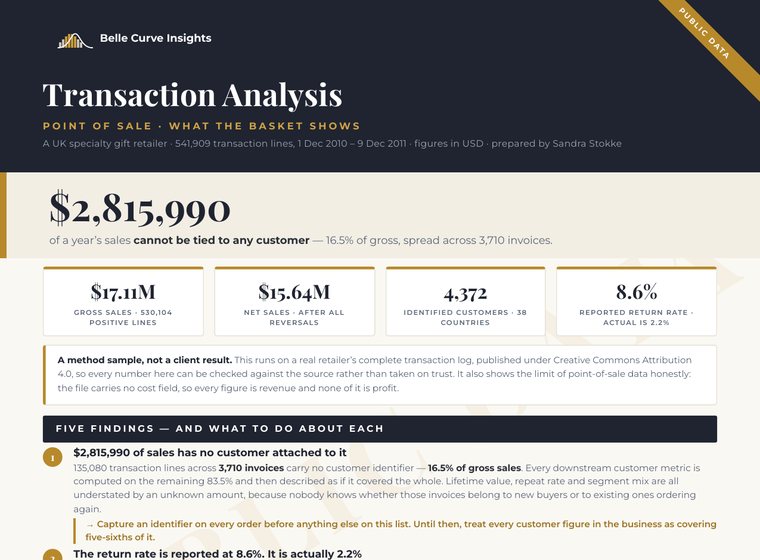
If your point-of-sale ties a transaction to a person — a loyalty number, an account, a repeat card, a booking name — a second set of questions opens up, and it is usually the more valuable one.

Almost every business we look at has the same shape hiding in its data: a small share of customers carries a disproportionate share of the profit, and another group costs more to serve than it returns. Owners can usually name their best customers by feel. They are right less often than they expect, because the loudest customer and the most profitable one are rarely the same person.

With customer-linked transactions you can answer things that change what you spend money on:

QuestionWhat it changes
Which customer groups actually carry the margin?Who is worth acquiring more of — and what you can afford to pay to get them
Did that promotion bring new customers, or discount the ones already coming?Whether to run it again, and to whom
How often does a good customer normally return?When silence means they have lapsed, and when it means nothing at all
What do the highest-value customers buy first?What to lead with, and what to stop leading with

An illustrative sample on synthetic data — the format and the questions are real, the shop is not.

This is the work I spent years doing for large brands — figuring out which customers drove profit and which quietly drained it, then deciding what to say to each group. The arithmetic does not change at smaller volumes. A business doing nine hundred transactions a month can answer these questions as well as one doing nine million, and can act on the answer the same week.

And when transactions don’t tie to a person

Plenty of businesses sell to people they never identify — cash sales, no loyalty scheme, no accounts. That rules out customer-level profiling, and anyone who tells you otherwise is guessing.

It does not rule out the analysis. It changes the unit from the customer to the basket, and for some businesses the basket is the more useful thing to study anyway:

Basket-level questionWhat it changes
What sells together, reliably?Bundles, placement, and what to put next to what
What does a given item pull along with it?Which low-margin lines are worth keeping because of what rides with them
How does basket size shift by hour and by day?Staffing, opening hours, and when to promote
What did that discount do to the rest of the basket?Whether a promotion grew the order or just shrank the margin on it

That last one is where a lot of money hides. A promotion is usually judged on whether the discounted item moved. The better question is what happened to everything else in the basket while it did — and that answer does not need a single customer name.

Which analysis is right depends on the business. A shop with steady anonymous footfall learns more from its baskets. A subscription service, a salon, or anything with repeat named customers learns more from the customer. Most businesses have some of both, and the audit starts by working out which side your data can actually support.

How it works

One standard export from your accounting system is usually enough to start. No new software, no IT project, and nothing to install. The audit is fixed-scope and fixed-fee, and you get a plain-English findings report with each item sized in dollars and ordered by what to do first.

See pricing →  ·  Book a free findings call →

See it in your own numbers

Where is the profit hiding in your books?

A Profit Leak Audit is a fixed-scope first look at your numbers, built from a QuickBooks export you already have. About a week, nothing to install.

Book a free findings call